Friday, November 30, 2012

A little ham radio experimentation.

I live at a relatively high spot for the area, but there are a couple of smaller hills between my home and the village of Marcellus, NY and the visage itself is located way down by the 9-Miles Creek. I hope to have a nice map/graphic to illustrate that. Anyhow, most repeaters don't make it to the village. I wanted to find a way to be in touch down there, especially since there are many places even the cell phone don't work in that rf black hole.


I decided to try out with my base radio set to cross-band repeat, from 70cm to 2m simplex. On one side, I used a Yaesu VX-7 set to tx/rx on 70cm, using 50mW of power, the base station, a Yaesu FT-8800 set to rx/tx at 5 watts into a high gain collinear antenna. Finally, my mini-van is equipped with a Kenwood D-700, set to tx at 5w into a quarter-wave mag-mounted antenna. In addition, I had an ht, a Kenwood TH-72 with a Smiley antenna, on high power, 5 watts. I made several contacts while on the way, first before I crested the infamous hills, then below it. All contacts were good. Once down in the village, the transmission got a bit scratchy, but quite understandable, meaning I may want to bump the power up a notch on the 2m side of the base radio. I then gave it a final try with the ht and I was quite pleased to hear things as well as with my mobile radio. The latter might benefit from a better antenna, but then it won't make it into the garage, so I can live with what I have now.

By using the lowest power setting I could on all the radios but the Kenwood by I used in the village, despite the known difficult location, I once again have proved that it is not so much the power one uses but the location and quality of the transmitting antenna that make a good signal. I realize I could have shown scientifically all I said above but to me, the final proof is whether it really will work, and that I got!

Friday, August 3, 2012

CQ WPX Awards

I finally got my 600th WPX mixed QSOs confirmed via LOTW. That means I qualify for the WPX Honor Roll.  Of course I need to apply and the LOTW fee is not cheap.  eQSL is free,  but I don't have enough confirmations via that system.

It will cost me about $87.00 or so to LOTW.  That's not cheap,  but at $0.12 for each QSO,  it is way cheaper than cards,  and a good number of those would have to go overseas,  so the saving is substantial,  let alone the long wait and frustration due to "lost"  mail etc.

I guess that at some point,  I'll pull the trigger,  get the three awards and endorsements,  but for now,  I  know I have all these QSOs not only in my log,  but confirmed,  so that makes me very happy.

Crap!  The imported jpg is impossible to read.  I guess I'll need to do it in a different way...


Thursday, July 19, 2012

WPX awards

I did participate in the IARU contest. Conditions were not great but I had fun! 120 QSOs, sure better than last year and even a new entity, Kuwait. My wire antenna worked very well, allowing me to use my beam in one direction while the wire was omni- directional. I could hunt with the wire, then hone in, if needed with the beam. I also made a few contacts on 40m and 80m, something I've rarely done, esp. 80m. I did try 160m but the antenna would not tune there and I also did not hear any contest stations. Now that I have an antenna launcher, eventually, if I come up with a good design and enough wire, I'll consider an extra antenna, as I do have the room and a wire is not too visible, especially when high enough. Sitting on 597 WPX Mixed QSOs, I expected that the IARU contest would put me over the top and on the WPX honor roll. Well, so far, I'm at 599, one below the 600 mark! I also had 60 QSOs with headquarters stations! I wish I had read the rules better as 75 would have given me a certificate, oh well:( But I certainly wish that HQ stations would use LOTW and log their QSOs in a timely fashion. None so far have shown on LOTW! Actually, I only have 17 new confirmed QSOs coming from the IARU contest! :( Now, while LOTW is a great tool for tallying WPX results, it will cost me about $70.00 to apply via LOTW and in addition, there will be the CQ fees. That's not cheap for wallpaper! Sure less expensive and more convenient than sending 600cards, but certainly something to mull, especially when I could print a screen dump of my eligibility to the awards and be happy with that! It certainly would be better than just my statement, as those are confirmed QSOs.

Wednesday, July 18, 2012

Antenna Launcher

For Father's Day I asked and got an antenna launcher www.joplin-arc.org This launcher is well priced, compared to others.

This is a wonderful device, easy to use and safe too, well, as long as you consider it being a loaded gun and act accordingly. Launching has virtually no kickback. Aiming is simple too.

So armed with the new toy, I decided to take my Cobra ultra-lite antenna down and relocate it so it can take full advantage of the mature trees I have on the property and at the same time be better oriented.


After a few hiccups, it went smoothly down, well this antenna has been up there for 5 years!  Putting it back up took a bit of work, as some trees were in the way and catching the wire, but all got solved and the gun performed flawlessly.

So now my antenna is at 48 feet above ground and I am happy with it. It refuses to tune on  160m but it never had. No loss there. It tuned nicely on the other bands and I did make quite a few QSOs with it already.

Tuesday, July 17, 2012

CQ WW SSB CONTEST Nov. 2011

Well, I did not have the entire weekend to devote to the contest, but I enjoyed it nevertheless. No pressure on me, I did what I could, when I could. Things started a bit on the wrong side, with part of my coax line to the Cushcraft MA5B going bad. Might have been just a connecting barrel that fell apart in my hands, the barrel I'll chuck, the coax, I'll check, pun intended of course. Fortunately, I had some spare coax, so I fixed that first thing in the morning.

20 meters was crazier than ever, so I migrated to 15m and 10m were I made most my contacts. Boy, I got to really use the narrow filter on my Icom 756proIII, and it certainly allowed me to separate between close signals. I also decided to try out the low power, single user, assisted category. I sure did enjoy the cluster and the stations appearing on my screen. I think that my days of non-assisted category may be over, as this is a more pleasurable way to search and pounce.

My new rotator worked well, but something is still wrong on the connecting cable so my control box does not show the antenna's direction. I just set a security camera looking towards the antenna and all day long, I could see where it was pointing at. Not so at night, but then I mostly used my wire antenna (difficult to change its direction tough, as the trees refuse to move on my command...)

One of the grand moments in a K9 SAR career

This post also never got publushed, it is also about a year old...

While you might expect the story of a find, or a great training feat, or a superb certification, this story might pale by them, yet it brightened my day and I still relish it a week afterwords and probably will do so for the rest of my life.

The dog, a chocolate Labrador retriever that I barely knew. But I have a very fond place for the chocolate labs, I do understand them quite well. I am also a fan of Cesar Milan. His way with the dogs matches theories I learned in the past, and these have worked for me quite well.

This chocolate lab, a SAR dog in training, was quite hyper about his tennis ball on a rope reward. Let's just say that the yellow cover was coming off the ball and the ball itself was half busted. That lab bit HARD on it and would not let go of it for his handler. The latter had to grab the dog by the harness and wrestle the ball out of its mouth, a real pity.

I approached the dog and claimed my space, which the dog gave me without a second thought. I was calm and assertive and the dog switched to a much calmer way and definitely was submissive. I asked the handler to give me the ball and I immediately threw it to the dog, not 30 feet, not 20, just 5 feet in front of the dog. The dog retrieved it, gave it a bite or two and I extended my hand and asked the dog to give me the ball. The first time, the dog missed my hand, the ball fell on the ground and the dog let me pick it up. Almost immediately, I threw it again, 5 feet away. The dog retrieved, saw my extended hand and put the ball in my hand. We practices a few more throws and the dog had total confidence in me, I could now take the ball, pocket it, pet the dog, talk to the owner, throw the ball, again 5 feet etc. Why 5 feet? The short distance kept the dog calm and focused and this is the mode a reward for SAR ought to be given, clam and focused as not to disturb the learning that just has occurred prior to the reward.

Rita, another now seasoned handler tried it as well, and had the same behavior I did.

Now came the owner's turn, and guess what, when thrown calmly, with expectation to get it delivered back to hand, it happened to him too. The shorter the throw, the better the retrieve and release. It took all of maybe 10 minutes and the handler learned a new way to reward his dog and in so doing, I think there was trust building between the two, something that was sorely missing in that equation.

As for me, I was surprised how quickly the dog gave me his trust. Maybe Stryder, my chocolate lab did talk to that younger dog. Who knows? Fact is, I could get the ball from the dog just by asking and a bit of body language.

AlexLoop Walkham PY1AHD


This is a post from almost a year ago, never got published...

I recently purchased the Alexloop Walkham antenna. Between the weather not cooperating among others, I did not have much time to spend outdoors, playing radio. So I am not going to call this a review of the product, b ut more a bunch of comments by an occasional user.

I got this antenna as I wanted to have a portable antenna that is easy to set up and needs little tweaking between band changes etc. The Alexloop filled those two requirements quite well. Putting it together is a breeze, an untrained monkey could do that. No small parts to lose or fiddle with, no tools required, nothing to measure, no counterpoise wires. It is up in a few seconds and has nothing my dogs or grandchildren will get tangled into.

Being a high-Q antenna, you need to re-tune it between changes in frequency/bands, but turning one knob to the highest reception level, then fine tuning it takes maybe five seconds... I can live with that, especially since the knob is at arm's length from my chair.

The next requirement from an antenna is that it would be a good receiving antenna. Simply, if you can't hear'em, you can't work'em. Well, tha Alexloop Walkham is an excellent receiving antenna. Can I say it is better than a SteppIr on a huge Luso tower? I can't as I have neither of those available, but I can hear stations and hear more of them than I can work. Not only that, with its null, I can cancel noise that otherwise would drown some stations out.

Now my last sentence might sound as it the Alexloop has problems in transmitting. Not so, but there, we have many extra and uncontrolled variables coming into play. Suffice to say that a fellow with that SteppIr, Luso tower and legal limit amplifier will send my 5 watts into smithereens. Not the antenna's fault... And many times the local operator (me) has not tweaked  the SWR well enough, or remembered to switch  the power back up, so my minimum power transmissions are really minimal thus not making it.

OTOH, I've made quite a few contacts in the US, sitting on my deck with the Alexloop. And yesterday, I made my first contact across the Atlantic, to a station in Italy. Not yet the 1000 miles per watt transmission but getting closer to it! Yes, with QRP you need to be lucky and I was as this guy had just started calling CQ so I did not have to break into a pile-up.

I'm happy with the Alexloop Walkham.

Sunday, July 10, 2011

IARU Championship 2011 or shooting yourself in the foot

Camping in the Adirondacks this year, so I had the choice of going QRP with my Yaesu FT-817 and Transworld antenna or low power with my Icom 706MKIIG, same antenna. Well, after setting up on Friday afternoon, I found that I had lots of noise, S9 and above... Since we were near the office, pool etc. I figured out they had some RFI problems inherent to the mechanical parts of the pool, refrigerators and what not. And campgrounds are known to have electrical problems anyhow. Not much I could do about it, certainly not saving my 24-hours contest...

So I opt for maximum power, set up the Icom 706MKIIG as my station and heard almost nothing but noise on all bands, 40m-10m, covering most of the band... I did manage a few DX contacts, in the 5000 miles range, something that would send he whooping and hollering on 5 watts, but less so on 100 watts. Sure, I'm just operating portable, with a good antenna, but still a compromise one, so I'm not unhappy, but I was hoping for better.

I even tried my FT-817, battery powered, outside the rig with my Alexloop antenna, one that has a directional pattern, but even with this, I could not null the noise. Made a few QRP contacts anyhow...

I had planned on staying up late at night, to improve on my score as much as possible, but conditions seemed so bad that I figured out it is not worth losing sleep over, so I went to bed.

I woke up in the morning, walked the dogs, all six of them are with us in the RV and then it dawned on me. I was using a spare cell phone/iPod charger, the same I used at home, but at home, I discovered its power supply made all kind of noise so I replaced it, this one, a spare, still had the original power supply. I turned the Icom on, to be greeted by S9 noise. I unplugged the sucker power supply and the noise was GONE! Well S2-3 is quite acceptable in a campground! And parts of the 20m band were totally quiet! Ugh! I feel so stupid. A less than $5.00 piece of Chinese crap robbed me of a beautiful day's contest!

When I get back home, I'll give this PS the 10lbs hammer test, meaning what happens to it when pounded by said hammer...

As for hunting the noise down, the RV is 30' long, and that makes it hard to pinpoint the noise. In addition, I have power lines overhead, the power receptacle and the stupid PS were within feet of each other so with only an HT, I don't think I could have zeroed on the real culprit, but I did not try, as I assumed wrongly tht the noise came from the campground...


So here is my score:


At least I participated!

Monday, June 13, 2011

ARRL June VHF QSO Party

With my wife visiting our grandchildren in PA and me dog-sitting at home, this is a perfect opportunity to try something new, as my activity on VHF has been relatively limited, especially on SSB, actually it was nil there.

So I started making plans, the weather having been quite hot, I wanted to operate from my deck, thus close to my antenna, as I was also the designated rotator... So by Wednesday, I got my equipment out, my little FT-817, my Arrow antenna and I listened/participated to my club's net on 2m FM, making sure that my equipment worked well. Passed that hurdle with flying colors.

But now the weatherman starts talking about colder weather for the weekend, with rain and well already by Friday, the nice weather was gone and we had a bit of rain. So I go to plan B, working from my screened porch. The screening material is metal, so it makes it a great Faraday cage. No transmissions come out of it, unless the antenna is outside, and that means mileage on the rotator's legs, mine!

Now, my Arrow has a diplexer built-in so I did not want it exposed to rain. I hauled my Elk out, checked it with my analyzer and it was fine, so it got the job. With that antenna, I could go to 200 watts so instead of my FT-817, I took the Icom 706MKIIG from the RV and that gave me a certain advantage as now I was able to transmit up to 50Watts on VHF. My computer easily connected to the 706MKIIG and I could have logging on-the-spot and even LoTW as I had wi-fi everywhere. So here I am, comfortably installed in the screened-in porch, working a few stations, when I noticed the sky getting darker and darker, my dogs, one by one going back inside... I had a plastic tablecloth to protect my equipment should high winds push the rain inside... At one point, I went to turn my antenna and the air felt funny, Just a single droplet of rain fell on me, the ground was dry. I turned my antenna by 90 degrees, to try listening to another quadrant. I got back in and my behind did not reach the chair when the sky opened up with a vengeance. Sheets of rain and wind... The tablecloth flew over the station and covered everything. I quickly disconnected the power, then the antenna and moved everything back to the kitchen island.  Reconnected everything, no damage and now, this is where the VHF station will stay till the Party is over.

Unfortunately, I keep hearing the same three, four stations and nothing more. One of then has a contest station, so my 706MKIIG and its Elk antenna slung on a painter's pole (held by duct tape) and bungee corded to the deck swing may not mean much. But maybe propagation will help a bit later on. Anyhow, it is not bad to be contesting without any pressure. Whatever will happen, it will be better than last year!

Well, I never heard any more stains than the four I logged. I will probably need a better antenna if I want to do better, and better propagation too. The antenna is not going to happen, too much expense for too little fun, IMO. So will I participate on VHF events in the future? I hate to say a definite no, and be proven wrong at a later time, but with my current equipment, probably not.

2010 10-Meters ARRL Contest

As you can see from my previous entry, I won first place in the Western New York Section, Single Operator, Low Power SSB. Sure, I'm tickled pink and happy to have sent in my meager results and now can prove that you may be 1st in your category, even with two QSOs. But I was hoping to do a bit better, score-wise at least, this year.

Propagation was not great, to say the least. I also had some equipment malfunction, like my rotator freezing (antenna pointing east) and some quirk in my Heil headset or mike switch, but that was fixed with me reverting to the old hand mike.

The frozen rotator freed me from having to look at propagation charts as my Cobra-Ultra-lite antenna and my Transworld Backpacker are omni-directional so all I could do is listen and answer calls I heard without possibility of enhancing them locally.

This time I'm claiming 26 QSOs and 728 points. This certainly eclipses 2 QSOs and four points from last year. Will it be good enough to win the category? Time will tell.

I worked a Canary Island station, one in Columbia, a few Argentinian stations, Aruba came through too as well as several Mexican stations. Several stations in the US were also worked, NY, AZ, FL, CA and IL. I want to thank the operators for taking my call.

Friday, December 10, 2010

2009 ARRL 10-Meter Contest

Well, just as I'm getting ready for this year's contest, and having by now completely forgotten about last year's, I get this nice certificate in the mail. Talk about a pleasant surprise!


Upon further review, I had only 3 QSOs on that contest, no wonder I did not remember it at all, as there was nothing to howl about. But given enough categories, Single Operator, Phone Only, Low Power, I probably had no competition in the WNY Section!

I sure am hoping to do better this year. I guess the goal might not be too high! I'm sure glad the score is not on the certificate, but that certificate sure has re-energized me and is a great motivator.

Thank you ARRL! This one goes on my wall!

Thursday, October 21, 2010

Monday, August 16, 2010

Israel's Critial Security Needs for a Viable Peace

Well, before Israel withdrew from the Gaza strip, I was not opposed to the withdrawal. It was IMO, worth the risk. Evidently, not only did it not work, it backfired... Who is to say that the Palestinian regime, a regime that is barely hanging in by its fingernails, will not fall and be replaced by Hamas/Jihad/Al-Qaida, just as it did in the Gaza strip? And this time, Israel cannot take many risks. Here is why:

Sunday, August 15, 2010

Garmin 62s track sampling most often vs 1 yard

First let me say that although these tracks were taken using the 62s, I believe that the sampling would be quite similar in the 60csx, Oregon, Dakota and Colorado as they have the same track sampling options and use the same or a very similar algorithm for that purpose.


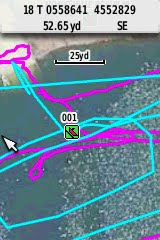
The cyan track is set at the most often sampling rate, in auto mode. The red track is set on 1 yard, distance. These were made during a K9 training, searching for divers under water. Each pass was for a different dog. THe difference is obvious, you want precision in the track, chose the sampling rate by distance, 1 yard.

I certainly cannot see the boat, a very nice FD inflatable boar, making an angular pass like in the cyan track. Below are two screen dumps directly from the 62s:


Now I also checked elevation profiles, as elevation was one point that was fixed in the latest beta and on the water, the elevation should be quite the same. Unfortunately, I did not set my GPS to barometric altitude, so that point was not checked. Yet look at the differences:


The cyan track (most often sampling) is on the left, the red track, 1 yard sampling is on the right. The water was not flat, just little waves, no white caps, wind about 5-10mph.

I will stay with my setting for track, 5 yards sampling on land, 1 yard on the water.

Thursday, August 12, 2010

Funny and cute: Tagging black bears in Algonquin Park, Canada

Altitude reporting on the Garmin GPSMAP 62s

As usual, click on the picture to see a larger version thereof. At first glance, the elevation graph seems to confirm that pressing a button on the 62s causes altitude spikes to be registered. Well, first, this is untouched data, as displayed by TopoFusionPro. At the start, I know I did set the tracking to be on, so I did press buttons and there is a slight, 10ft, loss of altitude whereas I'm in the parking lot. I don't know what caused the next two humps and depression between them but I did touch buttons around the 1.0 mark and the change there is not spectacular. I can't find a reason for any other spikes but the last one, when I was saving my track. 20 ft difference or so, I just eyeballed it, did not look at the actual track elevation numbers.

Do I want Garmin to look into it, perhaps fix it? Of course. But does it really matter to me for Search and Rescue purposes? Frankly, without others talking about it, I would not have noticed it, as I rarely even look at altitude. I rarely, if ever reset the barometer as altitude is of little consequence to me. My legs are good at telling me whether I'm going up or down and I can read the map (on the GPS or on paper).

The GPS graph shows altitudes between 320 to 370 ft, quite acceptable for my use.

Google Translate!

As a linguist, I find this amazing. An innovative idea, what else would you expect from Google, and mega computer power making it work. And while the results are not perfect and human touch is often needed, by now, I'd say any translation I would do, will certainly begin on a Google Translate base, then add the human touch to make it better.


Tuesday, July 27, 2010

World Trade Center 2009

I have not been to the World Trade center since September 2001 when Radar, my search dog and I worked in Staten Island's recovery effort. I did not want to really see that huge hole in the ground. Having watched this video, I cannot wait now till the area is going to be open to the public.


Thursday, July 22, 2010

GPSMAP 62S vs. Oregon 400i

I got the 62S for two main reasons. With age, near sightedness is a problem, and it is hard to rely on reading glasses in the woods. So I needed a better display than my Oregon 400i could offer. While the 62S has a lower resolution than the Oregon 400i, that lower resolution seems to make it easier for me to read it, and the brightness of the display is helping too, so that problem (of mine) had been addressed.

The 3-axial compass is easy to calibrate, easier than my Droid Incredible, and once that done, it is a pleasure to use, no more trying to level things out. Beautiful. Compared between the two and my trusted Brunton Eclipse and had the same results, all three compasses indicating magnetic north where it should be.

I tested both units on the road near my house, a complete square shaped circuit, mostly in the open but the south side, especially on the outside of the road comes next to tall trees in full foliage. First time around, I walked on the inside, clockwise. The second time around, I walked on the outside, still clockwise and I reversed the GPS position.
At first, in the open, I noticed both units being very close in numbers, in single numbers even, sometimes just a foot away from each other, well they actually were, as I held one in each hand! But further down the separation grew to six feet, the 62S always being the best. I had WAAS acquisition, quite strong on both units, satellite 48. I lost it for a brief moment on the southern leg on the Oregon, but it came back. Now on the second time around, still on my east leg, I noticed the Oregon becoming less precise, much less so than the 62S. I also noticed the WAAS reception was not so good on the Oregon and it was on satellite 33, whereas the 62 was on 48. I lost WAAS on the southern leg on the Oregon, while I did not on the 62S. Precision went down to about 18ft on the 62S but was double that on the Oregon at nearly 40ft. I was watching the satellite screen all the time on both units.


So how do the track look and compare?


On the left, the Oregon 400i's screen and on the right the 62S.

You can see that the scale is different as going to 120ft did not allow to have the entire picture on the 62S' screen.OTOH, on the Oregon at 200ft the two tracks almost blended, due to the higher resolution, I guess.

I would have been very pleased with either, as they show me on the correct side of the road, and this is not a major thoroughfare, mind you.

Look at the NW corner. On the outside, I had to decide when to cross the street and the way I crossed is better shown on the 62S than on the Oregon 400i. Looking at the SE corner, on the outside, I had to leave the edge of the road as it was overgrown there and the 62S shows it a bit better. Really, I am nit-picking, yet the 62 is the winner!
The maps displayed are not the same. The Oregon has Topo 2008 and NY 1:24000 topo that is displayed, whereas the 62S had the Garmin 1:24000 NE on a uSD card.

I will now put those tracks on an aerial in TopofusionPro and see if the win stays with the 62S.


OK, now we are talking magnification (click on the picture is you need to see it larger) and I see nothing further to add. The two units are darn good, with victory by points to the 62S because it tracked me more accurately in those corners and its WAAS fix was much more stable.

I was tempted to dig up files from the past, but then I remembered that GPS constellation would be different and also the GPS software and firmware would not be the same, thus introducing uncontrolled variables, so I'll stay away from that.

This is a work in progress, I'll add more as I do more. For now both units will accompany me in my forays, but I have a very sound feeling about the 62S. Scott from GPSFix fame told me he had tested the 60csx vs. the 62S and the display of the 62 is at least as good if not better than the 60csx because of the added colors. And his eyes are better than mine, I believe, certainly not as old.

I remembered I had a Gilsson external amplified antenna which I had not used since I got the Oregon. I found it nevertheless and since today is a rainy day, all I want to do is indoors testing. So here are the screens:


Left is with the Gilsson external amplified antenna, right naked 62S, same location, well read the UTM! I am indoors BTW. Location is as correct as I can place it on an enlarged aerial, altitude is right too, the only difference is the GPS precision circle and stronger reception of the satellites in general with the external antenna. Notice that WAAS is working fine (full bar with the external antenna) but I'm not far from a window. IMO, for SAR work, I don't see the need for the external antenna. I'll put it in/on my radio harness, to be used if conditions ever necessitate it, but not as routine use. I also noticed that the MCX connector is quite difficult to detach. I even used needle nose pliers.

Scott (GPSFix/wikis) had trouble transferring tracks adn Geocaches wirelessly. I tried too, from the Oregon 400i to the 62S and although both units indicated transfer completed 100%, I could not access these tracks on the 62S. Now upon checking via computer, I can see those files in the GPX folder! I have just restarted the 62S, still no-go! We may have a minor bug there!

The 62S at its worst!

I left my 62S on by my keyboard at my desk. I don't remember what I did check, but I forgot the unit on for just over an hour. Now my shack and computer are in the basement, facing a wall that is below ground. Behind me are stairs and the living room and only part of a window is visible, double pane glass, window treatment and behind it there is a huge tree in leaf. Most GPS units have no reception here, maybe if I hold them up so they have a better angle at the window and the satellite geometry is just right, but in most cases, I have no reception. Well, I have a track of 148 points, .52 miles long, my 62 being set at marking a point every 5 yards!

So here is the display on the 62S' screen:

And here on TopoFusionPro:


Well I measured the total deviation, north-south was 70 meters and east-west was 50 meters.

Frankly, I've seen much much worse from earlier Garmin units. Why did my 62S do that, simply the signals from the satellite were bouncing all over the place, my below ground wall being just two feet from the 62S, as well as my desktop computer and HF radio and other ham gear. I always like to know how my equipment will function in extreme conditions and although I did no set up this test, the results are interesting and actually, IMO quite good. Tomorrow, I'll leave the 62S in outdoors for a hour and we'll be able to compare results. Satellite geometry will be different but the placement should give it quite an advantage.

OK, so today, I left the OR400i and the 62S on the table on my deck, is good position to acquire satellites for over an hour and a half. Here are the results:

Screen size tell you which is the OR and which the 62S (ok the latter is on the left). Well, both did well, both in a 20ft diameter circle. Length of the "track" was different, maybe due to the extra sensitivity of the 62s' antenna? Now I did not take a screen dump of it but under a more normal working scale like 120, 200, etc. you can't even see that drift on the screen. Now for those of you who are looking for a 35mm film canister (Geocachers), you need to search for it in 314 square feet, a circle that has a radius of 10 feet.