That was a pleasant event, a round robin of problems, enough to make you and your dog happy. We were lucky weather-wise as the hear spell got broken the day before and the heavy rains made way to a really nice day.
Training is also where I test my gear, in conjunction with working my dog. This time it was my new Droid Incredible and its topo mapping capabilities as well as track saving.
One thing I learned is to put the darn thing in airplane mode in areas with no reception. This will help the batteries last longer. This is the main problem with cell phones in general, they die due of lack of power in wilderness settings. I already have a power pack on order, one that can not only recharge the cell phone but be recharged itself by AC/12v and/or SOLAR! Now solar panels are not so efficient when moving, as most of us will try to stay in the shade, but when stationary, it can be directed towards the sun to be as efficient as possible.
The Droid Incredible has apps that can save your GPS track to the unit and can also share them by email (and other means) with friends or yourself, so you can then open the email attachment you sent yourself and import the track in your mapping software. While this app, MyTracks, is Google based, meaning road map and aerial, Gaia GPS beta gives you a nice USGS map, but it is quite a dated one. Looks terrific though till I looked at my Garmin Oregon 400i with its 24K maps on a memory card and the picture there was by far better, crisper, as long as the light was right, as the Oregon's display is not the best (acceptable but not great). Gaia GPS beta allows you to download map segments ahead of time, quite useful when going in no reception areas. My Tracks left me with a blank screen.
PICTURES: you can click on each picture to see an enlarged version.
Here is a screen view from Gaia GPS Beta on the Droid Incredible, as it has a share option, so I emailed it to myself:
Below is a computer screen dump from MyTracks, this time I send the track to My Maps on Google Maps, so there is a way to share the tracks from the field, without a physical connection to the computer, if there is cell service.
I can make the Droid Incredible do most things My Oregon can do, but battery life and waterproofness are concerns. They can be overcomed but still, I prefer using a dedicated navigation GPS in the wilderness and save my battery on the Droid foir phone and pictures. OTOH, the ability to send tracks and photos is something to consider sometimes.
Below are two out of four photos taken of a "crime scene". 8-megapixels pictures that can be sent over the cell network and that ate geotagged, meaning the GPS location is encoded in the file and they can be placed on Google Earth for exact location!
As you can see from the shadow, I'm standing and yet you can count every shell casing! From a phone camera!
And below is my Google Earth screen dump and you can see the geotagging information encoded in the picture.
Road navigation:
The Droid Incredible and my Garmin Nuvi 765T did well, but when I missed a turn, the Nuvi recovered and the Droid got stuck (maybe because of lack of phone reception, I don't know, as I was close to my destination and driving on a dirt road that needed my full attention. I was using the Droid on car power to conserve battery.
We also had a M+C course. After 18 years in SAR, my compass does not even have a scratch on it! Am I an armchair SAR searcher? Heck no, but simply my Brunton Eclipse developed a huge bubble so I sent it back to Brunton and a few days later, a brand new compass appeared at my doorstep. Hey, I sent an old, beat up compass and got a brand spanking new one in return. And now I know it works just fine in the woods! One leg was a GPS exercise (like Geocaching) and while I found a glitch in my GPS, I cannot reproduce it, yet, glitch or not, I used my unit and found the cache.
During one of the breaks from K9 work I took, waiting for an area to become available, I put my low power ham radio station together, radio, battery, antenna and counterpoise wire, in less than five minutes I was on the air, hearing a lot of European stations (there was a contest going on) and managing to make a contact with a Florida station, working 5 watts, just like a portable radio! SAR, K9-SAR and my ham radio hobby all at once! Life is good!
With all this going on, Stryder, my dog, found his live subject as well as his "dead" and hanging one. I was particularly happy to see him work out a nice scent pool, get out of scent, then back in solving the problem by following the fringe to the source and indicating up the tree. He is an experienced dog, but beautiful dog work still gets to me. The day I tire of it may be the day I need to retire from K9 SAR!
Sunday, July 11, 2010
Field Day 2010
This year I decided to check out on my club's Field Day location. I came early and helped a bit in erecting their yagi. We finished just in time to have some lunch and we beat the rain. Erecting said antenna in the rain would have been unpleasant to say the least.
I then discovered that I was in a no-cellphone zone, and as CNY does not have many K9 resources, I felt I could not spend more time there, totally off the grid. Next year, I may just pass the local landline number to my wife and teammates etc... That premonition was well founded as I did get a call on Sunday!
I decide to operate in minimalistic mode, using just what was in my my fanny pack (a small one from www.powerportstore.com) and an 7A SLA that was on my screen porch and that I had used previously. Amount of power left in it unknown. I also had a 5A Li-Po battery that had been recently recharged as well as the internal 2.7A pack, also recently recharged. My old used SLA battery lasted me the entire field day! And yes, the poor think needs to be recharged now!
For next year, I want to be able to use a folding solar panel for recharging my battery (5-10 watts).
Antennas:
Well I used what was in the fanny pack the ATX and my Miracle MMD 20m antenna. No ATU, nothing else. I used the ATX on bands other than 20m, but just for a short while. Most of my work was done on 20m with the Miracle MMD antenna. I just threw the antenna from my deck to a tree, some of the antenna was horizontal, but did not go in a straight line to my rig (physical constraints of the house) and some was hanging vertically from the branches of my tree. Definitely not ideal but to me it simulated well a situation where I would be asked to get communications going in the shortest amount of time, no help, just get it done!
It got done! I had two contacts on Saturday. Competing with stronger stations was hard. I did better Sunday morning, four QSOs and I was hoping to achieve ten when a search call came to interrupt my Field Day. Since I started setting up well after the start of Field Day, regulations allowed me to operate an extra 3 hours. That's when I got most of my contacts for a total of 17. Those last few hours were good, as competition was much smaller and any station was ready to deal with a weaker signal just to get the points.
Next year, I might try operating later at night or in the wee hours of the morning, when competition is not as fierce.
Conditions were bad on 20 meters. I could hear a station loud and clear, nice and high on the S-meter just to have it fade within a few seconds.
I enjoyed working QRP. Life is not too short for it. Those who shun it don't know what fun it can be! Using 100w into a beam now seems like shooting fish in a barrel!
I think I'll continue using QRP next year. I would like to see batteries charged with a solar panel, work later at night or in the wee hours of the morning, and this time use my best portable antenna, the TransWorld Backpacker. The latter is also very easy to set up in a few minutes. But this year, I wanted to just use my fanny pack.
Now in real emergencies, I think that I still would like to be able to Tx with 100w. That means using my Icom 706MKIIG. But what I could do is use the FT-817 for listening and then turn on the IC-706MKIIG and using it to make the contact, once done, power it down till I'm ready for the next one. One of these Field Days, I may try this configuration and see whether I can conserve power while listening and still use 100w for Tx.
Logging:
I kept a paper log. With 17 QSOs this is not a problem. I don't even know if N1MM will do the (IMO excessive) paperwork ARRL wants us to do. I've never so far submitted my logs for FD, just for that reason. Maybe I'll do it this year. Who knows, 17 QRP/battery QSOs might just be enough to get a mention? I don't know if I want to use my laptop for logging, as while it may make things easier to log, it means a much more complicated and less portable station.
Well I just got a Droid Incredible and hopefully soon I'll be able to log from there and send the ADIF file to my email address and import it into HRD without too many problems.
I then discovered that I was in a no-cellphone zone, and as CNY does not have many K9 resources, I felt I could not spend more time there, totally off the grid. Next year, I may just pass the local landline number to my wife and teammates etc... That premonition was well founded as I did get a call on Sunday!
I decide to operate in minimalistic mode, using just what was in my my fanny pack (a small one from www.powerportstore.com) and an 7A SLA that was on my screen porch and that I had used previously. Amount of power left in it unknown. I also had a 5A Li-Po battery that had been recently recharged as well as the internal 2.7A pack, also recently recharged. My old used SLA battery lasted me the entire field day! And yes, the poor think needs to be recharged now!
For next year, I want to be able to use a folding solar panel for recharging my battery (5-10 watts).
Antennas:
Well I used what was in the fanny pack the ATX and my Miracle MMD 20m antenna. No ATU, nothing else. I used the ATX on bands other than 20m, but just for a short while. Most of my work was done on 20m with the Miracle MMD antenna. I just threw the antenna from my deck to a tree, some of the antenna was horizontal, but did not go in a straight line to my rig (physical constraints of the house) and some was hanging vertically from the branches of my tree. Definitely not ideal but to me it simulated well a situation where I would be asked to get communications going in the shortest amount of time, no help, just get it done!
It got done! I had two contacts on Saturday. Competing with stronger stations was hard. I did better Sunday morning, four QSOs and I was hoping to achieve ten when a search call came to interrupt my Field Day. Since I started setting up well after the start of Field Day, regulations allowed me to operate an extra 3 hours. That's when I got most of my contacts for a total of 17. Those last few hours were good, as competition was much smaller and any station was ready to deal with a weaker signal just to get the points.
Next year, I might try operating later at night or in the wee hours of the morning, when competition is not as fierce.
Conditions were bad on 20 meters. I could hear a station loud and clear, nice and high on the S-meter just to have it fade within a few seconds.
I enjoyed working QRP. Life is not too short for it. Those who shun it don't know what fun it can be! Using 100w into a beam now seems like shooting fish in a barrel!
I think I'll continue using QRP next year. I would like to see batteries charged with a solar panel, work later at night or in the wee hours of the morning, and this time use my best portable antenna, the TransWorld Backpacker. The latter is also very easy to set up in a few minutes. But this year, I wanted to just use my fanny pack.
Now in real emergencies, I think that I still would like to be able to Tx with 100w. That means using my Icom 706MKIIG. But what I could do is use the FT-817 for listening and then turn on the IC-706MKIIG and using it to make the contact, once done, power it down till I'm ready for the next one. One of these Field Days, I may try this configuration and see whether I can conserve power while listening and still use 100w for Tx.
Logging:
I kept a paper log. With 17 QSOs this is not a problem. I don't even know if N1MM will do the (IMO excessive) paperwork ARRL wants us to do. I've never so far submitted my logs for FD, just for that reason. Maybe I'll do it this year. Who knows, 17 QRP/battery QSOs might just be enough to get a mention? I don't know if I want to use my laptop for logging, as while it may make things easier to log, it means a much more complicated and less portable station.
Well I just got a Droid Incredible and hopefully soon I'll be able to log from there and send the ADIF file to my email address and import it into HRD without too many problems.
Monday, May 31, 2010
Close-Up Footage of Mavi Marmara Passengers Attacking IDF Soldiers
To me these pictures speak a ton. I don't need more to understand why deadly force had to be used.
And if more is needed, here is a long video from a non-Israeli source. Just notice the "peace" activists, with clubs, metal pipes, knives, gas masks
Monday, May 17, 2010
The Good Life Central NY Magazine May-June 2010
The Good Life, Central NY Magazine reporter, V. Michelle Bernard wrote a wonderful article about Search and Rescue, my SAR dogs and a bit about myself. The magazine is a very nice local publication but unfortunately has no web presence so I secured permission to publish the article here, on my blog.
The two pictures below will get larger and the text will be readable when you click on them. Use your back button to return to the blog and view the next picture in the same way.
The material below is (c) 2010 The Post Standard. All rights reserved. Used with permission of The Post Standard.

I would like to thank The Good Life, CNY Magazine for having published this article and a special thank you to Michelle Bernard for he excellent work writing this article. Michelle did a lot more than just interviewing me. She researched her facts, talked to others in my circle of SAR related friends and her professionalism showed throughout her work all the way to the finished product.
Wednesday, May 12, 2010
What QRP can do for you!
I got a brick today, meaning a Mirage BD-35 VHF/UHF amplifier I bid for on eBay. Fist thing, I wanted to see it worked! So I connected my tiny Yaesu VX-2 to my collinear antenna, something I've never done so far and I was really surprised by how well the radio worked with that antenna. All of 1.5 watts and with that antenna, I was reaching quite far, without the amp. So let it be a lesson, it is not the watts you put out it is what you do with those watts in the antenna system! This is something I've learned over time, but never experimented with and now I have a solid proof for it! Makes me happy!
Now with the amp, I could reach even farther repeaters and 1.5 watts was enough to drive the amp on VHF. The 1W I got out on UHF gave me only 10W out of the amp (still 10x improvement), but then I switched radios, put my VX-8 on line and now I got full power out of the brick.
My idea is to save buying another APRS rig for the RV and use my VX-8 with the brick, giving me the same output as any mobile radio and for the price I got the brick on eBay, I could not even come close to another APRS radio! Do I need the power? Well with the through the glass 1/4 wave antenna I have on the RV (I certainly did not want to make it any taller/higher than it is), I can use some help, so where the gain is low, the extra watts will hopefully help.
Now with the amp, I could reach even farther repeaters and 1.5 watts was enough to drive the amp on VHF. The 1W I got out on UHF gave me only 10W out of the amp (still 10x improvement), but then I switched radios, put my VX-8 on line and now I got full power out of the brick.
My idea is to save buying another APRS rig for the RV and use my VX-8 with the brick, giving me the same output as any mobile radio and for the price I got the brick on eBay, I could not even come close to another APRS radio! Do I need the power? Well with the through the glass 1/4 wave antenna I have on the RV (I certainly did not want to make it any taller/higher than it is), I can use some help, so where the gain is low, the extra watts will hopefully help.
Tuesday, May 4, 2010
Good news!
As I logged on to my LoTW account today, I noticed one new DXCC entity, Monserrat, the QSO having been made in 2009, but then I noticed the asterisk near the Phone and 20m tabs, meaning the award has been issued! Wow, I applied on April 26th, 2010 and we are just May 4th 2010! Now that is fast. I bet that just using LoTW had something to do with it! Now, I'm waiting for the paperwork but that ought not to take too long.
Saturday, April 24, 2010
Motivation
Often, at search scenes, when it is time to go home, we get a verbal thank you from a representative of the agency we worked with, which is always nice. Understandably, sometimes things can be a bit hectic and we just go home.
From time to time, the agency we worked for sends a thank you letter to the team, and most teams pass copies to their members, or participating members.
It is much less common to receive personal letters from the Chief of the agency involved in the search. It has happened to me a few times in the past but it is always nice and motivating to get such letters. Here is one I just got today:
Yet below is one of a kind, the only hand-written note I ever got from relatives of a missing person. This is definitely not the run-of-the-mill, very unusual and what more, we never even found the victim (was found at a later date outside the search area). That kind of note to is very invigorating, very motivating to say the least!
From time to time, the agency we worked for sends a thank you letter to the team, and most teams pass copies to their members, or participating members.
It is much less common to receive personal letters from the Chief of the agency involved in the search. It has happened to me a few times in the past but it is always nice and motivating to get such letters. Here is one I just got today:
Yet below is one of a kind, the only hand-written note I ever got from relatives of a missing person. This is definitely not the run-of-the-mill, very unusual and what more, we never even found the victim (was found at a later date outside the search area). That kind of note to is very invigorating, very motivating to say the least!
New DXCC awards
Well I just checked my ARRL LoTW account and low and behold I have a second and third DXCC Awards waiting for me to apply for. I knew for a while about the phone award, as I am sitting on 109 QSLs but I was inching along on the 20m award getting very close but now I've got it too, 100 QSLs!
It sure makes me happy and more energized and eager than ever. I'm doing ok on RTTY and 15m so I will concentrate my efforts there, the bands allowing of course.
I have now to figure out the LoTW application process which should not be too hard as this one is a pure LoTW application. While I have more cards, I'll keep them for when I really need them and work at getting more from QSOs I've made but not send cards, waiting for LoTW confirmations.
It sure makes me happy and more energized and eager than ever. I'm doing ok on RTTY and 15m so I will concentrate my efforts there, the bands allowing of course.
I have now to figure out the LoTW application process which should not be too hard as this one is a pure LoTW application. While I have more cards, I'll keep them for when I really need them and work at getting more from QSOs I've made but not send cards, waiting for LoTW confirmations.
Monday, March 29, 2010
2010 WPX SSB Contest
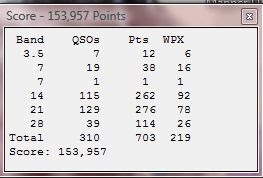
Yes, with 310 QSOs and a score of 153,957, I beat my result in the 2010 CQ WPX RTTY contest, but I worked longer 27hrs 32 minutes compared to 19hrs 28 minutes. Phone contacts take longer, I'd say but I would have to validate that with other scores to generalise. I am happy with those results though. I did compete in the TB-Wires overlay category, so maybe I have a chance to see my scores published...
This time I decided to give the newest version of the N1MM contesting logging software a try. Thanks David K2DSL, for convincing a pig headed ham to try it out. OK, really not kosher pun there right before Passover! It performed pretty well for me, with a few moments of panic and a lot of saved files for backup (I did not trust it fully, so I was prudent). Some of my problems stemmed from not heeving read the 4000+ pages manual, fortunately in pdf form and searchable, which allowed me to solve some of the problems while contesting. Others remained unsolved as they were not critical. All I can say is that I logged all my QSOs, did not lose any to the program. I avoided dupes and the only ones I did call were due to call signs errors. This part worked much better than HRD. At the end of the contest, the Cabrillo file was created very smoothly. While contesting, I discovered I was elligible for the TB-wires category overlay and I did not know how to do change that with N1MM, so I did it manually, a breeze when compared to entering a whole column of data. BTW, I never send in my CQ WPX RTTY log because I had to edit so many entries. That made me decide to seriously try N1MM as I was not ready to do so much paperwork after a contest. I don't know how people managed to do it before computers...
I made 310 contacts with 56 different entities (most are countries, but not all). From Alaska in the north to Hawaii and the Galapagos Islands in the west, Chili and Argentina to the south, Morocco and Senegal in Africa, to Russia in the east. That's a lot of ground, but there is a lot more out there.
Band-wise, 160m was a bust, I heard some station but they never heard me, 80m was not very productive, but then I was not up late at night, 40m was ok, not great either. 20m was my strongest but 15m was right up there with a huge number of South America stations, a pleasure to work them. Finally 10m showed up too and made me very happy to operate on it. While I did call CQ several times, mostly on 20, 15 and 10 meters, I did not get any replies so my score reflects a search and pounce strategy.
I did not hear too many local stations on the air or being replied to, but AB2TC and I were playing cat and mouse over the same stations for a few minutes. I don't know if he heard me though.
20 meters at times became very challenging, as it was so loaded with signals that it became hard to pull them apart. I first found solace on 15m as there were many stations and making QSOs was relatively easy but on 20m, I had to use many bells and whistles my Icom756ProII has and indeed, I managed to isolate signals and making contacts. It was time consuming though. My MO5A antenna was still frozen on Friday night and Saturday morning, but temperatures got up in the day and never got much below freezing after that, allowing me the use of the rotator. I will replace that el-cheapo Rat-Shack one with a decent one that can be computer controlled. That is my next step/expense for my base station. And now the weather is starting to allow thinking about getting on the roof...
This hour-by-hour breakdown shows me where the weaker work hours are. It seems that 10-11 UTC, or 6-7 EST are not very productive, under double digits, so I could stay in bed longer, but my dogs wake me up anyway... But maybe staying up later at night might be worth while, especially working 40 and 80 meters. I may want to try that. I also noticed a drop in the afternoon of the second day, well, most stations were dupes for me, so all I can do is try harder and maybe call CQ a few more times.
That is one thing I need to set up in N1MM as it has more memories available than my 765ProIII. I also then can keep the full spectrum display and not bother with voice on the radio. RTFM!!!
Monday, February 15, 2010
CQ WPX RTTY Contest
CQ WPX RTTY Contest 2010Well, this is my best contest score so far. And I worked only 19 hours and 28 minutes out to the 30 hours allowed. I did not loose sleep and had quite a few other things do do over the weekend, So I really can be happy with the results.
My Cushcraft MA5B rotator, a simple Radio Shack one, probably got water in its cogs as it will not rotate when temperatures are below freezing, and that antenna while functional only in the north easterly direction is not producing heat (not a cloud warmer) so the ice does not melt in the rotator. At least it was pointing towards Europe. There is plenty of snow on the roof, no time to fool with antennas now.
I made some new DX contacts and have now Wales and Norway confirmed via LoTW. I also hope to get a confirmation from New Zealand. I made contacts on 80, 40, 20, 15 and 10 meters. Only two on ten meters but that's better than none.
The contest happened just on a the weekend when I got my Ten-Tec 715 Speech Processor. It did not do me any good on an RTTY contest but I hope that it will help me break a few pile-ups easier in the future. I installed it today and it seems to be working hopefully making my voice more intelligible and stronger in lands far away. While I know that an amplifier will help, I prefer working on my antennas and signal first before inserting raw power.
Monday, February 1, 2010
A song I remember from my youth
Well, the grand-children might have a ball laughing their heads off... That's OK.
It was also made as a movie, ham radio related, about hams of all backgrounds and countries getting together to assist in the rescue of a ship at sea...
You can watch the movie here:
http://www.ch73.net/player.php?id=308&table=1&ln=gb
Enjoy!
Ham Radio Contesting
Some good news concerning a ham radio contest. Did I win or place? No, I'm not competing at that level, just trying to get better scores each time I'm actively participating in a contest. But 13th place in my region, I'll take it any day!
Thanks for CQ Magazine for making the certificate available on line. Such a good idea!
Monday, January 11, 2010
Search in Camillus NY
I went on a search on Sunday, with my K9 partner Stryder. We did not find anything meaningful but I saw a blue heron. Unfortunately, by the time I grabbed my camera, it had flown away. Since I saw it next to a parking lot, I returned there while doing some errands today. This time my camera was ready. At first all I saw from the truck was this nice family of Mallards.
But then, I decided to park the truck and walk a bit and indeed I saw the Great Blue Heron hiding on the other side of the creek. I snapped a few pictures, distance did not matter as I had a 18x optical zoom. So here it is, waiting for fish to pass... Remember to click on the pictures to get an enlargement.
Friday, December 18, 2009
A dream come true?
I can just dream of driving this think to the grass airfield in Marcellus and take off to a search, land, drive to search base and then either work my dog, do some air searching, then fly back home!
And can you see it as toad behind our RV, get to some place, drive to stores, do a fly-by on the campground?
OK, it is a toy, a big one, and definitely not in the budget, but can one have a dream? I don't even have a pilot's license...
Sunday, December 13, 2009
SWR Exposed
This is really for hams, not so interesting to others, I'd say but one never knows for sure
Friday, December 11, 2009
Wednesday, December 9, 2009
Monday, November 23, 2009
Glace Bay Nova Scotia
Last summer, my wife and I and our six dogs took our first long trip with the RV.We went to Canada via VT, NH, ME, NB, NS, QC and ON. While we made good preparations for the trip, we managed to keep our pland flexible enough to allow for changes as we discovered new things to do and places to visit.
After the thrills of driving the Cabot Trail with a 30' RV, certainly one of my high points of the trip, not Kathy's though...
Well, I was cheating a bit, as the Oregon GPS was showing a topo map and I knew what was expecting me well before I reached the next curve...
It was while we were driving that Kathy discovered on her Blackberry that Marconi had a station in Nova Scotia. Once we arrived to our cmground, I investigated a little further and decided I really wanted to see the place. We made sure it would be open when we expected to get there, made a few changes in our plans, and we went to Glace Bay. Here is what we found.

After the thrills of driving the Cabot Trail with a 30' RV, certainly one of my high points of the trip, not Kathy's though...
Well, I was cheating a bit, as the Oregon GPS was showing a topo map and I knew what was expecting me well before I reached the next curve...
It was while we were driving that Kathy discovered on her Blackberry that Marconi had a station in Nova Scotia. Once we arrived to our cmground, I investigated a little further and decided I really wanted to see the place. We made sure it would be open when we expected to get there, made a few changes in our plans, and we went to Glace Bay. Here is what we found.
A modest but nice museum commemorating Gulielmo Marconi's work and especially the establishment of his second station from where he communicates across the Atalantic Ocean with his station in Poldhu. While there now is controversy whether Marconi actually heard the letter "S" sent across the Atlantic in Morse code dit-dit-dit, and I won't touch that any further, there is no question that transatlantic transmissions emanated from this station at Glace Bay. The towers were wooden so the only thing that is left from 1901 are the foundations as you can see in the pictures below.
The museum has a nice station and the local ham that was operating it offered to let me use it. I opted to use my own portable station in the RV with my TransWorld antenna. Making contacts was not easy as I was so close to the VE1VAS's yagi antenna, which was transmitting CW at 1KW, but eventually I made a contact with a European station, LY20A from Lithuania. There was an Italian station I really wanted to talk to, as I'm sure an Italian ham would have loved being contacted from that location but unfortunately he went QRT. Here I am, in Glace Bay, with my little portable station in the RV, and with Kenna my yellow lab and Stryder my working SAR dog, a chocolate lab (you can barely see his head at the bottom).

Wednesday, November 11, 2009
Another DXpedition Rapa Nui Easter Island 2009
It is not easy to break in the pile-up that a DXpedition has, especially form a very desirable location. It takes time and patience, especially with a modest station and antenna. I had time to check the island out on Google Earth and boy, it is nice over there.
Today was the first time I heard the signals from XR0Y in Easter Island at a level where I knew I had a chance to make it through. Still, I'm battling big gun stations with mega antennas and amplifiers. The operator was first calling for European stations and giving a time later on for US ones. When they switched to US stations, there was a large pile up. I tried quite a few times to get through but was not lucky. The operator was working split, transmitting on one frequency, listening on another five kH up on the scale. But when the pile-up grew too much he asked to spread the calls on 10kH and I happened to pick 8kH up for my Tx frequency. My call was answered very quickly and I sure hope I am in their log. I guess that knowing how to operate my rig, doing it fast and with a bit of luck, 100 watts made it through!
These guys are GOOD! Not only do they update their log quite often, they also use Twitter to announce it! Hats off! They really use every bit of technology at their hands to get information through. They definitively deserve some support!
Sunday, November 1, 2009
Saturday, October 31, 2009
CQ-WW-SSB 2009 Contest
I had lots of fun with this contest. It did not start well for me though. First, I had intended to give a trial run to the N1MM contesting logging software a week before that at teh NY QSO Party, but I was too tired aftera train ride and a long day in Old Forge NY to operate my station let alone with new software. So when thsi contest came, I had not even prepared its logging file. So it took me a few minutes to do that and then things seemed to work out OK but I noticed some problems, with the software, including it not staying connected to my radio and thus not logging the frequencies correctly and a few more minor glitches. So I decided to revert to my trusted regular logging software, Ham Radio Deluxe and again it took me a few more minutes to set a new log up but then I was up and hopefully running. That first evening was disappointing, conditions were awful and I soon called it quits for the night, as I saw not reason to stay awake just for a few QSOs that I might be able to make. Things remained slow early in the next morning but started getting better as suddenly the 15 meters band opened, while the 20 meters was so crowded it was difficult to make calls there, unless you had am amplifier. I'm operating at low power, 100 watts maximum, single operator, non-assisted. So I made quite a lot of contacts on 15m. Things quieted down in the evening, again I saw no reason to stay awake overnight. I had 117 QSOs so far, not bad, kind of opening the possibility to beat my own 181 QSOs record. On Sunday, things got really busy on 20m and almost as busy on 15m. I got busy and in the afternoon I had beaten my own recors and now was forging ahead, setting a 200 goal, reaching it, setting a 225 goal and reaching it too. I finally set my sights on 250 QSOs and reached that goal with 15 minutes to spare in the contest. I decided to quit there, claimnig a score of 89206 points. Some calls are multipliers and the math is too cumbersome for me to figure it out, that's why I have a computer!
I ran into troubles with the Cabrillo formatted log I am to use to report my activity. Saving my ADIF file from Ham Radio Deluxe, and using adif2cabr to get the Cabrillo file, I lost a colums of data. Using the HRD ADOF file and importing it into N1MM, then exporting a Cabrillo file from N1MM, I got a file where the frequencies were not right, there were some mistakes in the file mainly in Canadian calls (15) but I had the missing column. So I Took the Cabrillo file I got from adif2cabr, imported it as text file to Excel, imported teh N1MM cabrillo file into a different sheet in Excel, copied the missing column from the N1MM cabrillo file and pasted it into the adif2cabr file in Excel. Saved that Excel file as a text file, used Note Tab Lite to check it, reformatted it a bit, just added some tabs for clarity (although the file would have read correctly, but I like my columns well aligned and send the file in. It was accepted quite easily by the robot.
Why did I write all this? Simply, so I'll remember next time, if I bump into similar problems and if someone else needs that information, I got it here.
Do I expect to win? Heck no! Some of the big gun stations amass millions of points. But I already have accomplished my goal, my score is yet higher than ever before, I've also found some ways to improve on my operation. I started controlling my transmission via computer, instead of the foot switch. Takes a lot less coordination and my dog can sleep at my feet without being distrubed. I also used VOX, voice activated transmission, but I have to be careful as whatever I say may be trransmitted, including what I say to my dogs oand/or wife...
I ran into enough problems with N1MM to scrub it and revert to HRD. N1MM is supposed to be a very good contesting software. I'll give it another trial at a more minor contest and see if I can use it efficiently. I know that some of the problems I had were due to user error. The 400+ pages manual doesn't help much, too much information when you need quick answers but I've found a few shorter versions that may just put me on the right track. I already found some answers to problems I had so it may be worth another look. Also, if I get it to log right, then the Cabriullo file export will be a breeze, something I really like, especially since now, I tend to ahve a log that is getting longer and more problematic to edit, even if just for formatting.
Friday, October 23, 2009
Topofusion and kmz files for the Oregon/Colorado/Dakota
I happen to be one of the beta testers for Topofusion and a few days ago, I had requested from Scott Morris, the brain behind Topofusion to check out is kmz file export would be possible in Topofusion (TF). I got my answer yesterday night with a new beta version ot TF Pro that can do exactly that. Topofusion offers you WYSIWYG, what you see is what you get on your Oregon/Colorado/Dakota. Anything on TF's screen can be sent to the Oregon, topo map, aerial, color aerial etc. Even custom maps, and TF really shines here as the georeferencing is simpler and much faster than Google Earth and if you downloaded the mapping tiles ahead of time, you don't even need internet access to georeference a user map.
What more, I made these maps using a 6-megapixel picture taken with a camera I use for SAR. When on a search, I hate having to play with cameras settings or with jpg file that need to be shrinked etc. It is all easy to do but these are details that distract me from my main task. Once the user map is georeferenced in TF, the screen display is 1274 pixels wide by 853 in height sending out a kmz files of 106-140KB.Also, I enlarge the screen display on TF and made three kmz files, the UTM grid helped tremendously in making sure I don't have huge overlapping areas or worse, holes in my coverage.
Once on my Oregon, the three files are there on screen, and I can scroll seamlessly from one area to the other.
Thank you Scott, for coming up with so far the best and easiest way of sending maps to the Oregon!
Thursday, October 22, 2009
On GPS and sense of direction.
Please read the article mentioned in the link.
http://www.walrusmagazine.com/print/2009.11-health-global-impositioning-systems/
It is quite interesting.
Online Exclusive: Does My Sense of Direction Suck? from The Walrus Magazine on Vimeo.
I have been a GPS user since the early nineties. As units became better, the system matured, I have relied more and more on GPS navigation. I now use GPS as my main navigation tools.
I've also been blessed by a very good sense of orientation, ever since I was a kid. My mother used to tell a story that when I was about 7 years old, she was shopping in Naples Italy and it was time to return to our ship. Only my mother was walking uphill... My mother said I constantly told her to go downhill but she never listened util she took a cab and dow the hill it went... I've always been very aware of my surroundings and I navigate by terrain features, topography, land cover and man-made objects.
Has the use of GPS lessened my sense of orientation? Well, I don't know what's going inside my head, but I don't think I lost any of my natural abilities. Why? Well, most of my outdoors activities are related to canine search and rescue. I have to interpret what the dog is tellng me and how the scent might propagate. So navigation while important, is not the only factor I am using. In order to help put my dog in a position of success, I still have to look at the wind, the topography, the terrain cover, well, see the common points with navigation? So I think that I kept using the same skills for a different purpose and thus, they never dulled.
And I can certainly understand that even a skilled navigator might lose their skill when relying solely on instruments such as the GPS. But then, aren't maps and compasses also instruments? Maybe they deserve the same caveat as the GPS? As I see it from the article, Inuits navigate a lot like I do, using natural elements to guide them. And the secret of preserving the skill lies in using them, trust your GPS but verify its findings, using the traditional methods.
http://www.walrusmagazine.com/print/2009.11-health-global-impositioning-systems/
It is quite interesting.
Online Exclusive: Does My Sense of Direction Suck? from The Walrus Magazine on Vimeo.
I have been a GPS user since the early nineties. As units became better, the system matured, I have relied more and more on GPS navigation. I now use GPS as my main navigation tools.
I've also been blessed by a very good sense of orientation, ever since I was a kid. My mother used to tell a story that when I was about 7 years old, she was shopping in Naples Italy and it was time to return to our ship. Only my mother was walking uphill... My mother said I constantly told her to go downhill but she never listened util she took a cab and dow the hill it went... I've always been very aware of my surroundings and I navigate by terrain features, topography, land cover and man-made objects.
Has the use of GPS lessened my sense of orientation? Well, I don't know what's going inside my head, but I don't think I lost any of my natural abilities. Why? Well, most of my outdoors activities are related to canine search and rescue. I have to interpret what the dog is tellng me and how the scent might propagate. So navigation while important, is not the only factor I am using. In order to help put my dog in a position of success, I still have to look at the wind, the topography, the terrain cover, well, see the common points with navigation? So I think that I kept using the same skills for a different purpose and thus, they never dulled.
And I can certainly understand that even a skilled navigator might lose their skill when relying solely on instruments such as the GPS. But then, aren't maps and compasses also instruments? Maybe they deserve the same caveat as the GPS? As I see it from the article, Inuits navigate a lot like I do, using natural elements to guide them. And the secret of preserving the skill lies in using them, trust your GPS but verify its findings, using the traditional methods.
Wednesday, October 21, 2009
Raster pictures on my Oregon
A couple of days ago, we had a search in Highland Forest Park, NY. Stryder, my dog never got out of the truck, as the victim was found by the Sheriff's department trailing bloodhound, but since I had the time, I started making a raster map of the park fr my Oregon. I quickly took a couple of digital pictures of the park's trail map, two maps, one for snowshoeing trails and the other for x-country ski trails (they are getting ready for winter fun).
I did not change the camera's settings (6 megapixel camera) when I took the pictures. That gave me files of about +/-2.5Mb. Georeferencing with Google Earth was ok, but I really prefer the quick method that Topofusion has, just click on 3 points on the layer and the base map/aerial. Much simpler, quick and easy. I talked to Scott of Topofusion about making kmz layers with TF, especially as if I download the maps prior to leaving home, I can then use TF even without internet access.
The screen dump below is of the 2.5 Mb file
This screen dump is with a jpg taken at 2 megapixels resolution giving a kmz file of +/-950Kb. The map is a 24K topo map in both these pictures.
This last picture is the same as above the only change being the map, this time it is the Garmin Topo 2008.
I noticed that the re-draw of the screen is faster with the smaller kmz files, but still the 2.5 Mb files were quite usable. That means that if I have to do some hasty work and don't reset the camera back to 2 megapixels, the results are not going to bite me back. Actually the lesser trails show better on the larger files and since I would be moving at pedestrian speed, screen redraw speed is of lesser importance and it is more important to me to better see the secondary trails too. I also have ample room on my 8GB uSD card.
Another lesson learned is that when you have two kmz files of the same area, only one shows on screen. I have not managed to find out the reason why one has precedence. The only solutions I see for now are either move one file off my uSD card (needing a computer -which I have in my truck) or putting them on two different uSD cards (and try not to lose/misplace those - good luck).
I did not change the camera's settings (6 megapixel camera) when I took the pictures. That gave me files of about +/-2.5Mb. Georeferencing with Google Earth was ok, but I really prefer the quick method that Topofusion has, just click on 3 points on the layer and the base map/aerial. Much simpler, quick and easy. I talked to Scott of Topofusion about making kmz layers with TF, especially as if I download the maps prior to leaving home, I can then use TF even without internet access.
The screen dump below is of the 2.5 Mb file
This screen dump is with a jpg taken at 2 megapixels resolution giving a kmz file of +/-950Kb. The map is a 24K topo map in both these pictures.
This last picture is the same as above the only change being the map, this time it is the Garmin Topo 2008.
I noticed that the re-draw of the screen is faster with the smaller kmz files, but still the 2.5 Mb files were quite usable. That means that if I have to do some hasty work and don't reset the camera back to 2 megapixels, the results are not going to bite me back. Actually the lesser trails show better on the larger files and since I would be moving at pedestrian speed, screen redraw speed is of lesser importance and it is more important to me to better see the secondary trails too. I also have ample room on my 8GB uSD card.
Another lesson learned is that when you have two kmz files of the same area, only one shows on screen. I have not managed to find out the reason why one has precedence. The only solutions I see for now are either move one file off my uSD card (needing a computer -which I have in my truck) or putting them on two different uSD cards (and try not to lose/misplace those - good luck).
Wednesday, October 14, 2009
Oregon vs Garmin 60CSx track precision revisited
If you look down my blog to the February7, 2009 entry, you will see some older results which are no longer valid, as there have been major software changes in the Oregon and even one in the 60CSx. Just 8 months, but such a difference!
Below are yesterday's tracks:
Well, you probably like the aerial picture better, that's an improvement too, but looking at the tracks, what can we see? Remember, clicking on the picture will enlarge it nicely.
I started by going clockwise, on the right side of the street, following traffic laws, as I was on my electric bike. Both units were in the waiste pockets of my jacket and that means they were switched around when I turned around for the second go around the block.
My conclusions: frankly, both results are very good. I think the Oregon is a triffle more true in a few places, but really does it matter? We are talking single feet in distance and look how much I had to blow the picture up in order to even see it. It is well beyond the precision expectations of either instrument.
I'm really happy with both of these GPS units.
Below are yesterday's tracks:
I started by going clockwise, on the right side of the street, following traffic laws, as I was on my electric bike. Both units were in the waiste pockets of my jacket and that means they were switched around when I turned around for the second go around the block.
My conclusions: frankly, both results are very good. I think the Oregon is a triffle more true in a few places, but really does it matter? We are talking single feet in distance and look how much I had to blow the picture up in order to even see it. It is well beyond the precision expectations of either instrument.
I'm really happy with both of these GPS units.
Tuesday, October 6, 2009
Unprepared
Sometimes it is good to know that even totally unprepared, a well trained SAR K9 will work things out and perform 100%.
Well, things did not start too well this morning and Stryder, my working SAR dog regurgitated his breakfast and the gobs of water only Labrador retriever can guzzle down. OK, major clean-up time so I managed to lock up the 5 other dogs in the living room and got Stryder downstairs to the basement and the fenced in back yard.
Once the clean-up done, I decided to pick up the back yard, as it was Monday, meaning also trash day. So here I was, busy with the pooper-scoopers and Stryder was just hanging lose. Now I needed to get out of the yard and get my heavy laden plastic bag to the end of the driveway. Stryder wanted to come along. I then remembered that I had planted a training aid for him, the previous day, not too far from where we were about to go. Well, I knew Stryder was not ready to work and didn't even have that in mind, but what the heck, let's see what might happen. I opened the gate, got my bag out, closed the gate and from the corner of my eye, I saw Stryder heading towards some bushes, blessing them in his canine way and suddenly his nostrils flared, his tail started wagging and he followed the scent stuck to the wet leaves to the side of the house and to the location of the training aid. Not only that, he performed a perfect refind, hitting my right hand and showing me the way to the target. I didn't even have his reward toy but I praised him lavishly and we ran to my truck where his toy was stashed behind the back seat, and ended the session in a lot of play and rough-housing.
I was really happy to see my dog working it out like that, totally unprepared. I think that I gave him as little cues as I could, walking uphill with the contents of my poop bucket... Not exactly the picture I normally try to project in training or searches. And no other cues were given, such as the reward toy or search vest etc. And in addition, the training aid was the lightest I have, so the problem was not easy to begin with. He's a good search dog, that Stryder pup of mine!
Well, things did not start too well this morning and Stryder, my working SAR dog regurgitated his breakfast and the gobs of water only Labrador retriever can guzzle down. OK, major clean-up time so I managed to lock up the 5 other dogs in the living room and got Stryder downstairs to the basement and the fenced in back yard.
Once the clean-up done, I decided to pick up the back yard, as it was Monday, meaning also trash day. So here I was, busy with the pooper-scoopers and Stryder was just hanging lose. Now I needed to get out of the yard and get my heavy laden plastic bag to the end of the driveway. Stryder wanted to come along. I then remembered that I had planted a training aid for him, the previous day, not too far from where we were about to go. Well, I knew Stryder was not ready to work and didn't even have that in mind, but what the heck, let's see what might happen. I opened the gate, got my bag out, closed the gate and from the corner of my eye, I saw Stryder heading towards some bushes, blessing them in his canine way and suddenly his nostrils flared, his tail started wagging and he followed the scent stuck to the wet leaves to the side of the house and to the location of the training aid. Not only that, he performed a perfect refind, hitting my right hand and showing me the way to the target. I didn't even have his reward toy but I praised him lavishly and we ran to my truck where his toy was stashed behind the back seat, and ended the session in a lot of play and rough-housing.
I was really happy to see my dog working it out like that, totally unprepared. I think that I gave him as little cues as I could, walking uphill with the contents of my poop bucket... Not exactly the picture I normally try to project in training or searches. And no other cues were given, such as the reward toy or search vest etc. And in addition, the training aid was the lightest I have, so the problem was not easy to begin with. He's a good search dog, that Stryder pup of mine!
Tuesday, September 29, 2009
GPS
I got my first GPS in 1994 or so. Since,I've always had one around me... I just hope I'm not as geeky as the guy below:
Monday, September 28, 2009
2009 CQ World Wide RTTY Contest
RTTY: September 26-27, 2009
Starts 0000 GMT Saturday Ends 2400 GMT Sunday
What is RTTY? It stands for radioteletype, nowadays a modernized way of communication utilizing a computer to digitize the message and to then send it to the radio for transmission and vice-versa for reception. I can see each signal on my screen, appearing like a waterfall, two lines with separation. In busy times there can be many such lines on my screen and I use the mouse to cursor to the one I want to have decoded. I can also peek at the others simultaneously. I can also hear each signal, as they each have a distinctive sound and between the visual and the auditory signals, I can time my transmission so it comes out when the other station is not transmitting and hopefully listening. The purpose of the contest is to make as many contacts as possible with stations in other continents, other countries and even other states or provinces. These are called multipliers and they are used to multiply your score by the factor they are given. While it "pays" more to have as many contacts as possible with other countries, it takes more time and amassing more local calls is just as important, as they are easier to make. Well, I hope I did not distort things too much here.
I was mostly at home this weekend and and could spend quite a lot of time contesting. I did take quite a few breaks, had dinner both on Friday and Saturday night with family, slept well at night, so it certainly was not an all-out effort. Just having fun there. I did not even look at my few previous contesting scores, I just did what I could and was happy with the results. I talked to a few Canadian provinces I've never talked to before on HF, such as Newfoundland, Nova Scotia and Prince Edward Island. I talked to many states, including several QSOs to Alaska and one to Hawaii. I also talked to about 32 different countries among then two new ones, Latvia and Andorra. I was lucky enough to get through to the C37URE DXpedition there and they very graciously took my call. Thank you, this is a rare gem! I also want to thank JJ1ZEJ for taking my call. This is the fist time since May of 2007 that I manage to have a QSO with Japan. Thank you also to all 181 station that took my calls and/or responded to mine. You all made it fun anad I hope you had fun too. And finally, thank you too to the CQ organization for making this contest possible.
This is my second RTTY contest. When I checked this morning, last year I had 39 calls I logged. So I did much better this year. More experience, better utilization of my logging program, Ham Radio Deluxe v.5.0. This time, I learned to use a separate log for the contest and I also set the other logs I had so there won't be a lookup there, and this way any duplicate call that showed up was from the contest only. By now, I also had good macros pre-programmed and I did modify them a bit to even make them better. As the contest went along, I also used good macros I saw from others to set my own CQ calls and replies. This made things so much simpler. I also started calling CQ several times. I may not have been patient enough as I got only a few calls back, but hopefully next contest, I'll do better in this department too. So now, I already have a new good reason to want participate in next year's contest!
Actually, I had set my goal to achieve at least 150 calls logged in the contest. I ended up with 181, so that by itself is rewarding. But when I checked my contest entries, it turns out that 181 beats my best score which was 165 with was in the 2009 CQ WPX SSB contest. These scores are raw scores, my log entry, not what was formally accepted. Am I earning awards, certificates or plaques? No, not yet, but placing well and doing better each time is what I'm after. I can't complain about my station, but I'm certainly not a "Big Gun", just utilizing my 100 watts as well as my antennas allow me to. So I'm competing against myself mostly, and I'm happy with the progress.
RVing and hamming in Canada.
My wife and I decided to spend our summer vacation RVing in Canada. We did a lot of planning, got books and maps and decided on an itinerary. Our motor home is a 30' Winnebago Sightseer and can comfortably transport both of us and our doggie family, six dogs, 3 Labrador retrievers, a German shepherd malamute cross, a super sized beagle and a border terrier.
I installed a Kenwood D-700A with a Larsen through the glass antenna (I hate making holes in something that expensive and mag mounted antennas don't work too well on fiberglass…). That antenna performed very well for me. At some point, on a Canadian highway, the antenna started hitting the side of the RV, something it had never done before and a quick glance showed it was getting unscrewed from its on-glass base. Fortunately I found a place to stop relatively safely. I could not reach the antenna from the ground, but with my tall step stool, I finally did manage to retighten it with a multi tool. That evening, I took care of the problem, as I set the threads with my wife's crazy glue and that seemed to have solved the problem permanently. I had a Garmin 60CSx GPS attached to the Kenwood and both worked APRS quite happily. Our family could then follow our progress on www.aprs.fi, that is, if our signals reached an I-gate.
The 60CSx was also my back-up navigation GPS. I used a more advanced Garmin Oregon for daily navigation, as it had a better display and the touch screen was easier to program, or re-program when we made last minute changes in our plans.
Our trip took us from Syracuse NY to Vermont, New Hampshire, where I had planned to stop at Ham Radio Outlet in Salem, but I realized then that it was a Sunday and they were closed! So we did stop at Cabelas, an outdoors equipment store that dwarfs anything in Central NY including Bass Pro Shop or Gander Mountain and we also stopped at LL Bean in Freeport Maine. From there, we entered Canada via Calais ME. We continued through New Brunswick to Nova Scotia and Cape Breton.
My wife, who does not drive the RV is a wonderful co-pilot. While I did the navigation, as I was very familiar with the GPS (from my SAR experience), she worked her magic on the Blackberry and found many answers to all kind of trivia questions that we had about the places we saw or passed through, their history, etc. And since our plan had some flexibility built-in, we managed to make changes along the way, as we discovered new interesting places to go, see and do.
I had packed my portable HF station, an Icom 706MKIIG and a TransWorld Backpacker antenna. That antenna came just a couple of days before our trip and I only had a single opportunity to make sure it worked at all, right from our front lawn and not for very long as I was busy with preparations for the trip. But the single trial convinced me to take that antenna and leave my Buddipole at home, not even take it as a spare.
To do justice to the Buddipole, it is not a bad antenna, it does perform quite well but I found it tedious to set up and tune and I knew I would not have much time to play around with my radios and wanted to maximize the fun. The Transworld antenna is so easy to setup even a caveman can do it (thank you, Geico). Actually, with a little practice, I can set up my entire station in 5-7 minutes or less, as I now no longer need to use an antenna analyzer or a tuner. I took both with me and never used them!
I had fun making contacts from every Province we visited, each time with a different call sign, K9CHP/VE9 (New Brunswick), K9CHP/VE1 (Nova Scotia), K9CHP/VE2 (Quebec) and K9CHP/VY2 (Prince Edward Island).
My wife found out about one jewel that really made this trip worth while ham-wise. Kathy discovered, via her Blackberry, that Marconi had built his second trans-Atlantic transmitting station in Glace Bay NS. Having just toured Cape Breton and the Cabot Trail, we made a little detour that got us to Glace Bay and the Marconi National Historic Site. It has a small museum and is located right where Marconi erected his station after having been ejected from Newfoundland by the local power company who claimed excusive rights. Anyhow, while this station was never perfect and Marconi later on built yet another one south of Glace Bay, it still was working for quite some time. All that is left today is the masonry base of the wooden antenna towers. That is where I planted my TransWorld Antenna, well close enough but not on the very base and tried working my own station. There is a ham station on location and I was invited to use their station, but I preferred trying with my own. Perhaps it was a mistake, as I got a lot of QRM from that station operating on CW with a large Yagi and amplifier, but I nevertheless made a single contact with a station in Lithuania. I heard an Italian station too, but he went QRT, too bad as I'm sure he would have appreciated that call, but I made it from there to Europe, with my tiny station, using the built-in generator of the RV as power source.
I made more contacts, one to Greenland from Prince Edward Island as K9CHP/VY2. Too bad I can't use that one for my DXCC count as it is a new one and not a very common one either.
And it was all made possible due to the TransWorld Backpacker antenna, as its setup is simple and easy and it performs quite well, for standing a mere 8 feet off the ground at its highest point.
From Nova Scotia, we went back through New Brunswick to Quebec. The latter is a wonderful province, and they were extra friendly to us, as for once they dealt with an American that spoke fluent French. We finally made it home through Ottawa and Ontario.
Friday, September 18, 2009
Rosh Hashanah
I know my father would have liked to see this video. He managed to escape from France to Spain through the Pyrenees mountains and from there ended up in Palestine where he joined the British Army and served in the Jewish Brigade. He ended the war in Belgium, actually not that far from Metz, his home town, and not very far from where the service mentioned in the video took place either.
So here we go:
So here we go:
Rosh Hashanah and the Shofar
This is how is ought to sound, always!
Unfortunately I can now understand where the dog is coming from!
Thursday, September 10, 2009
HPM/140 Birthday Celebration Event
While this was a week-long event, I only found time to participate in the last two days. I first set up my portable station in our screened porch as the weather was just fine for that, my Icom 706MKIIG and the TransWorld Backpacker antenna. The setup of that portable station is quite easy and takes me about 5-7 minutes from antenna to radio and up on the air! No tuning, no tuner, no analyzer, just put the 8 antenna pieces together, chose the band and place the two connectors, run the coax, connect it to the radio, connect the radio to the power source, either power supply or battery booster and battery, connect the mike and earphones and that is it!
Yes, I can get fancier and have the computer control my radio and log my calls. That takes a few more minutes. And If I want to operate on digital modes, that too takes another minute or two.
I love to keep it simple and as efficient as I can. So I made a few /140 contacts from this station but then went to the shack to log them as it is easier to get the log printed there, so I worked a few more from the main station and antenna.
Here is a screen dump of my log (click on it to see a good sharp picture):


I want to thank the ARRL for making this celebration possible. It was lots of fun!
As you can see, perhaps not too clearly as the screen dump may be a little fuzzy but if you click on it, as suggested, , the real picture will appear by miracle, propagation was interesting, with lots of stations fron CA and even HI and two from AK, but very few from the Mid-West (other than later on on 40m) and none from the NE or the east coast other than FL. I even tried RTTY and had one contact, but I was really not setup for that, did not have my macros ready like I do in contests, so it was a little tedious and there were not many station on that mode anyhow.
Yes, I can get fancier and have the computer control my radio and log my calls. That takes a few more minutes. And If I want to operate on digital modes, that too takes another minute or two.
I love to keep it simple and as efficient as I can. So I made a few /140 contacts from this station but then went to the shack to log them as it is easier to get the log printed there, so I worked a few more from the main station and antenna.
Here is a screen dump of my log (click on it to see a good sharp picture):

I want to thank the ARRL for making this celebration possible. It was lots of fun!
As you can see, perhaps not too clearly as the screen dump may be a little fuzzy but if you click on it, as suggested, , the real picture will appear by miracle, propagation was interesting, with lots of stations fron CA and even HI and two from AK, but very few from the Mid-West (other than later on on 40m) and none from the NE or the east coast other than FL. I even tried RTTY and had one contact, but I was really not setup for that, did not have my macros ready like I do in contests, so it was a little tedious and there were not many station on that mode anyhow.
Friday, July 24, 2009
DXCC
Well here it is, and this is also a good opportunity to thank the ARRL for offering the award, the LoTW for making is so much easier and cheaper than dealing with cards, which I still like, but they are slow coming in.
Of course I'd like to thank all the stations that answered my call. I do not have a huge big gun station, but use a rather modest 100w at the low end of the solar cycle. My antenna pales next to a SteppIR but evidently it is adequate enough for now.
I will continue chasing the DX as I'm not done with it and would like to get as high up as I can, maybe now being the right time to add some power to the station.
Thanks to all that made it possible!
Me thinks I'm King Kong!
Yesterday I was in NYC on some business. I opted to walk down 34th Street, window shopping and it was good exercise. I had my Oregon 400i with me and decided to save a partial track. Satellite reception was OK, not stellar (I should have saved screen dumps but thought about it only now), about 35ft accuracy. WAAS was off. I was receiving about 8 satellites 4 of which were not full bars.
New Yorkers need not worry, I was walking on the north side of the street, did not cross it till I got to 9th avenue (the B&H stoire, a shrine for gadget freaks like me). I did NOT, repeat NOT climb up any building, or swing wildly from skyscraper to skyscraper...
So why did the GPS show that? I guess the signal was bouncing between those buildings just like King Kong in the movie. Thus the reception was degraded and so was the result.
What is interesting though is that the most of the inaccuracy was on the N-S axis not on the E-W one.
In any case that would have made things quite difficult if I had been in a vehicle.
Before I'm asked, the GPS was on lock on road, so that is not why I had these errors. Sampling was either on 10yards or 5 yards, not that it is relevant.
I like testing my equipment and finding its limitations. The urban canyon certainly showed it struggled there.

New Yorkers need not worry, I was walking on the north side of the street, did not cross it till I got to 9th avenue (the B&H stoire, a shrine for gadget freaks like me). I did NOT, repeat NOT climb up any building, or swing wildly from skyscraper to skyscraper...
So why did the GPS show that? I guess the signal was bouncing between those buildings just like King Kong in the movie. Thus the reception was degraded and so was the result.
What is interesting though is that the most of the inaccuracy was on the N-S axis not on the E-W one.
In any case that would have made things quite difficult if I had been in a vehicle.
Before I'm asked, the GPS was on lock on road, so that is not why I had these errors. Sampling was either on 10yards or 5 yards, not that it is relevant.
I like testing my equipment and finding its limitations. The urban canyon certainly showed it struggled there.
Monday, June 29, 2009
My Field Day 2009
Well I planned on camping with the motorhome at the Ontario County Park at Gannett Hill, some 2000 feet up, operating my Iconm 706MKIIG with a Buddipole, either on battery power or on regular power.
We arrived there, I set the motorhome up, we had lunch, my wife was comfy, reading her book then taking a nap and I was setting up the Buddipole when I saw water leaking out to the motorhome. The site did not have water, so I was depending on the water tank and it was leaking. I decided that the safest think for us to do, was to return home. Which we did.
By then, it was past dinner time and I was tired and hungry. We fed our seven dogs (who were with us in the motorhome) and had dinner. I was too tired to do anything with radios, so it was up to bed.
Turned out that this was Radar's (my 9-11 SAR dog) last camping trip with us too. I did not know it at the time, but I'm glad he managed to be again at a place he really liked. And Chip, my first SAR dog also had his last camping trip at Ontario County Park, a place he loved too, so while not planned, these two dogs really followed each other's footsteps.
On Sunday, I decided to just operate my home station, I was really not in the mood to do much of anything, so I worked some stations on RTTY, BPSK-31 and phone, 40m, 20m and even 15m. Nothing to howl about. I was just trying to take it easy and have some fun, no pressure to compete or get any major results. I took many breaks, my wife and I also did some planning for our coming summer trip, so it was not a total wash of a day, but that leak sure put a damper on my Field Day.
I also finally made the decision that the Buddipole antenna is not for me. I learned a lot using it and it was fun. It is a very well made product but I need something that is easier to set up and just as efficient if not more. So I ordered a TransWorld Backpacker antenna and will give it a try as soon as it gets here. I hope to be using it on our trip. Since we'll be staying in some places just overnight, a quick setup time is of utter importance and so is the changing of bands. It seems that the TransWorld Backpacker will do just that for me. I can't wait till its here. And next year, I hope to use it on Field Day!
We arrived there, I set the motorhome up, we had lunch, my wife was comfy, reading her book then taking a nap and I was setting up the Buddipole when I saw water leaking out to the motorhome. The site did not have water, so I was depending on the water tank and it was leaking. I decided that the safest think for us to do, was to return home. Which we did.
By then, it was past dinner time and I was tired and hungry. We fed our seven dogs (who were with us in the motorhome) and had dinner. I was too tired to do anything with radios, so it was up to bed.
Turned out that this was Radar's (my 9-11 SAR dog) last camping trip with us too. I did not know it at the time, but I'm glad he managed to be again at a place he really liked. And Chip, my first SAR dog also had his last camping trip at Ontario County Park, a place he loved too, so while not planned, these two dogs really followed each other's footsteps.
On Sunday, I decided to just operate my home station, I was really not in the mood to do much of anything, so I worked some stations on RTTY, BPSK-31 and phone, 40m, 20m and even 15m. Nothing to howl about. I was just trying to take it easy and have some fun, no pressure to compete or get any major results. I took many breaks, my wife and I also did some planning for our coming summer trip, so it was not a total wash of a day, but that leak sure put a damper on my Field Day.
I also finally made the decision that the Buddipole antenna is not for me. I learned a lot using it and it was fun. It is a very well made product but I need something that is easier to set up and just as efficient if not more. So I ordered a TransWorld Backpacker antenna and will give it a try as soon as it gets here. I hope to be using it on our trip. Since we'll be staying in some places just overnight, a quick setup time is of utter importance and so is the changing of bands. It seems that the TransWorld Backpacker will do just that for me. I can't wait till its here. And next year, I hope to use it on Field Day!
Wednesday, May 20, 2009
DXCC progress
May 20th, 2009
The mail just came and with it a QSL card from Niger, my 39th DX QSL card. Adding to that 61 other LoTW DX entities, I now qualify for the DXCC award! All I have to do is sort the cards, fill-in the paperwork and mail it and the cards to the ARRL and wait for their approval etc. I hope the wait will not be too long.
Guess what, I could not wait any further and applied on line to have the 61 LoTW credited, sorted my cards, printed out my application and mailed the whole kit and kaboodle via Priority Mail with Delivery Confirmation to the ARRL.
May 22nd, 2009
I just saw that my letter with the DXCC application and 39 cards has arrived this morning at the ARRL offices in Newington CT. Delivery Confirmation is a great service for such matters. Now I have to hope I sorted the cards right and that everything else will be ok.
June 10th, 2009
Checking on the ARRL's website it looks as if I have an 8 weeks wait at least. As of now, they are working on the applications received by April 10th. Nothing else to do but wait patiently. Meanwhile more LoTW came in and they are more than welcomed of course. The DXCC is just one goal almost achieved, but eventually, I have my sights on the Honor Roll.
The mail just came and with it a QSL card from Niger, my 39th DX QSL card. Adding to that 61 other LoTW DX entities, I now qualify for the DXCC award! All I have to do is sort the cards, fill-in the paperwork and mail it and the cards to the ARRL and wait for their approval etc. I hope the wait will not be too long.
Guess what, I could not wait any further and applied on line to have the 61 LoTW credited, sorted my cards, printed out my application and mailed the whole kit and kaboodle via Priority Mail with Delivery Confirmation to the ARRL.
May 22nd, 2009
I just saw that my letter with the DXCC application and 39 cards has arrived this morning at the ARRL offices in Newington CT. Delivery Confirmation is a great service for such matters. Now I have to hope I sorted the cards right and that everything else will be ok.
June 10th, 2009
Checking on the ARRL's website it looks as if I have an 8 weeks wait at least. As of now, they are working on the applications received by April 10th. Nothing else to do but wait patiently. Meanwhile more LoTW came in and they are more than welcomed of course. The DXCC is just one goal almost achieved, but eventually, I have my sights on the Honor Roll.
Monday, May 11, 2009
Birds visiting our feeders
Thanks Kim, Olivia and Steve for the new bird feeders that have attracted so many beautiful birds to our deck!

Downy woodpecker (male)

Rose-breasted grossbeak (male)

Hairy woodpecker (male)

Brown-headed cowbird (female)

Red-bellied woodpecker (male)

Yellow finch (male)

Brown-headed cowbird (male)

Downy woodpecker (male)
Subscribe to:
Posts (Atom)